Can I use a Slate Bottom Pool Table for carom billiards?
As a supplier of Slate Bottom Pool Tables, I often get asked whether our tables can be used for carom billiards. Carom billiards is a fascinating and skill - demanding game that differs from traditional pocket billiards in several key aspects. In this blog, I'll explore the feasibility of using a Slate Bottom Pool Table for carom billiards and provide insights based on the characteristics of both the game and our tables.
Understanding Carom Billiards
Carom billiards is a family of cue sports that are played on a table without pockets. The objective of carom billiards is to score points by making contact with two or more balls with the cue ball. There are different types of carom billiards, such as three - cushion billiards, straight rail, and balkline. These games require a high level of precision and control from the players.
One of the most important aspects of a carom billiards table is the playing surface. The surface needs to be extremely smooth and consistent to ensure accurate ball movement. The speed of the balls and the angle of reflection are crucial factors in carom billiards, and any irregularities on the table can significantly affect the game.
Characteristics of Slate Bottom Pool Tables
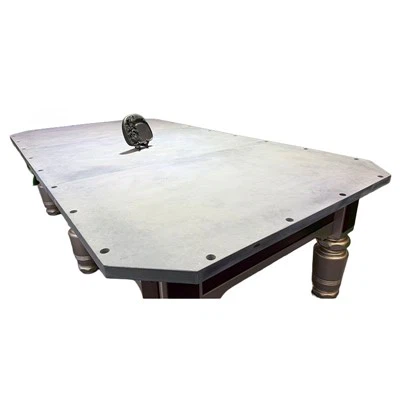
Our Slate Bottom Pool Tables are known for their high - quality construction. The slate used in our tables is a natural stone that offers several advantages. First of all, slate is very hard and durable. It can withstand the constant impact of the billiard balls without warping or getting damaged easily. This ensures that the playing surface remains flat and consistent over time.
The smoothness of the slate surface is another key feature. Slate can be polished to a very high degree, providing a nearly frictionless surface for the balls to roll on. This smoothness is essential for accurate ball movement, whether it's for pocket billiards or potentially for carom billiards.
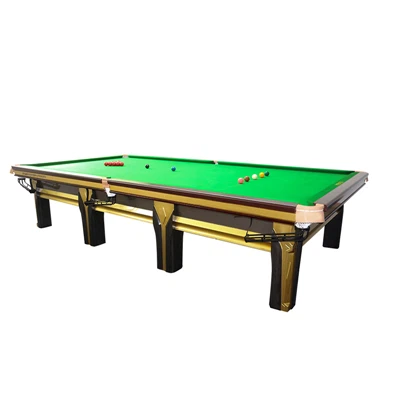
However, there are some differences between the requirements of a carom billiards table and a standard pool table. Carom billiards tables are typically larger than pool tables. The standard size for a carom billiards table is 10 feet by 5 feet, while a common pool table size is 8 feet by 4 feet. The larger size allows for more complex ball trajectories and longer shots, which are characteristic of carom billiards.
Feasibility of Using a Slate Bottom Pool Table for Carom Billiards
While our Slate Bottom Pool Tables have many qualities that are suitable for billiards in general, using them for carom billiards has both pros and cons.
Pros
- Surface Quality: The smooth and flat slate surface of our tables can provide a good foundation for carom billiards. The consistent surface allows for predictable ball movement, which is essential for players to plan their shots.
- Durability: The durability of the slate ensures that the table can handle the wear and tear of regular carom billiards play. This means that the table will maintain its playing characteristics for a long time.
Cons
- Size: As mentioned earlier, the size of our standard pool tables may be smaller than the ideal size for carom billiards. The smaller playing area may limit the types of shots and strategies that players can use.
- Pocket Markings: Our pool tables are designed with pockets, and the markings and indentations around the pockets may interfere with the ball movement in carom billiards. These markings can cause the balls to deviate from their intended paths.
Modifications and Adaptations
If you are interested in using our Slate Bottom Pool Table for carom billiards, there are some modifications that can be made. One option is to cover the pockets with a smooth surface to eliminate the interference caused by the pocket markings. This can be done using a special material that matches the color and texture of the table surface.
Another consideration is to adjust the cushioning of the table. Carom billiards tables often have different cushion characteristics compared to pool tables. The cushions need to be firm enough to provide a consistent rebound for the balls. You may need to replace the cushions on our pool table to better suit the requirements of carom billiards.
Comparing Different Types of Slate Tables
We offer different types of slate tables, including Solid Slate Pool Table, Real Slate Pool Table, and Slatec Pool Table. Each type has its own unique features.
Solid slate tables are made from a single piece of slate, which provides the most consistent and flat playing surface. Real slate tables are also of high quality, but they may be composed of multiple pieces of slate that are carefully joined together. Slatec tables are a more cost - effective option that still offers good playing characteristics.
When considering using these tables for carom billiards, the solid slate table may be the best choice due to its superior surface consistency. However, the other types can also be adapted with the appropriate modifications.
Conclusion
In conclusion, while our Slate Bottom Pool Tables may not be the ideal choice straight out of the box for carom billiards, they can be modified to meet the requirements of the game. The high - quality slate surface provides a good starting point, but adjustments in size, pocket covering, and cushioning may be necessary.
If you are interested in using our Slate Bottom Pool Tables for carom billiards, we are more than happy to discuss the possibilities with you. Our team of experts can provide guidance on the modifications and adaptations needed to make the table suitable for your needs. Whether you are a professional carom billiards player or a hobbyist looking to try something new, we can work with you to create a table that meets your expectations.


If you have any questions or would like to discuss purchasing a Slate Bottom Pool Table for carom billiards, please feel free to contact us. We look forward to helping you find the perfect table for your game.
References
- Carom Billiards World Confederation (CWC) official documentation on game rules and table specifications.
- Billiards industry research reports on the characteristics of different types of billiards tables.